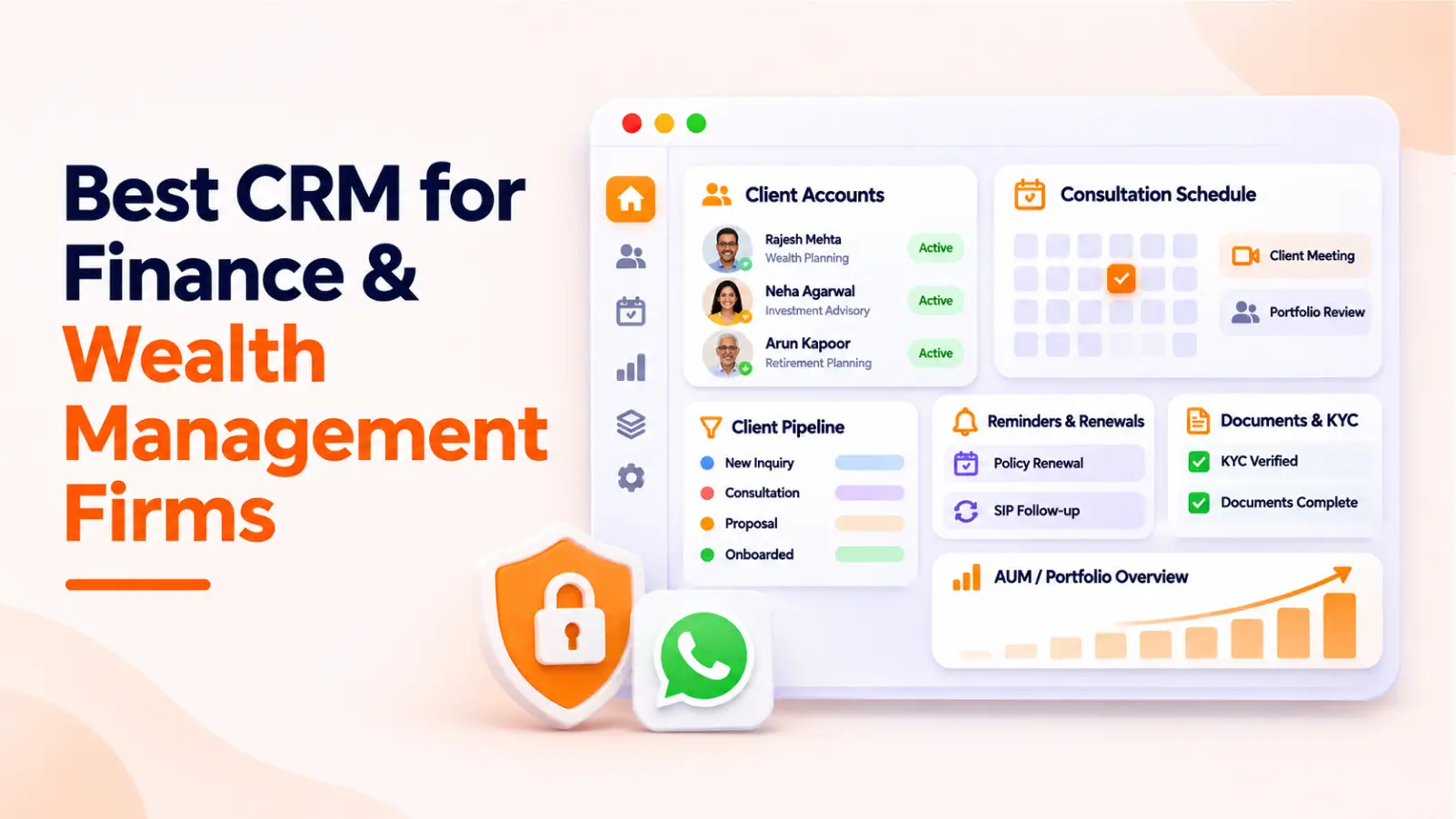
Best CRM for Finance & Wealth Management Firms
Compare the best CRM for wealth management and financial advisors, with security checks, pricing and tips to pick the right fit for your firm.
- 1Why Finance Firms Need a Different CRM
- 2What a Financial Services CRM Should Do for Your Firm
- 3Compliance and Data Security Checks Before You Choose a Wealth Management CRM
- 4Best CRM for Financial Advisors and Wealth Management Firms Compared
- 1. AiEngage CRM
- 2. Salesforce Financial Services Cloud
- 3. Wealthbox
- 4. Redtail CRM
- 5. Zoho CRM
- 6. HubSpot CRM
- 5How WhatsApp and Automation Improve Client Engagement for Financial Planners
- 6How to Pick the Right CRM for Wealth Management Based on Firm Size
- 7Conclusion
- 8FAQs
- Question: Is a general CRM safe for storing client financial data?
- Question: How much does a wealth management CRM cost?
- Question: Can a CRM help with compliance for financial firms?
- Question: Do financial firms need WhatsApp integration in their CRM?
Ask an advisor what really costs them clients, and the answer is rarely the market. It is the callback nobody made, the renewal that slipped by, or the KYC form still sitting in someone's inbox.
Clients forgive a bad quarter. They don't forgive feeling ignored. When one family can stay with your firm for twenty years, the system that tracks every promise matters as much as the advice itself. Here is the short version of which CRM fits which kind of firm.
The best crm for financial advisors depends on your market and team size. Indian advisory, insurance, and loan firms that work on WhatsApp get the most from AiEngage CRM, while banks lean towards Salesforce Financial Services Cloud. Small US firms usually pick Wealthbox or Redtail, and budget- or marketing-heavy teams look at Zoho or HubSpot.
Why Finance Firms Need a Different CRM
In most businesses, a salesperson closes a deal and moves on. Advisory work is the opposite. The relationship starts after the first investment and runs for years through reviews, renewals, and family changes. I have seen teams keep SIP dates in Excel and client chats on personal WhatsApp, and when an advisor leaves, that history leaves too.
The client base keeps growing. AMFI's October 2026 data shows India's mutual fund industry managing ₹83.39 lakh crore, with close to 10 crore SIP accounts contributing ₹32,160 crore in that month. Each one belongs to someone expecting timely updates.
One family can also hold several accounts across products, and every file carries private documents. Our guide on choosing the right CRM for your industry covers the basics.
What your firm needs | Generic sales CRM | CRM for wealth management |
|---|---|---|
Client view | One contact, one deal | Household view with linked accounts |
Relationship | Ends at the sale | Continues through reviews and renewals |
Documents | Simple attachments | KYC checklists with pending items |
Communication | Mostly email | WhatsApp, calls and email in one timeline |
Reminders | Deal follow-ups | SIP reviews, renewals and maturity alerts |
What a Financial Services CRM Should Do for Your Firm
When I plan a CRM setup for an advisory team, I first ask what happens to a client between the first inquiry and the yearly review. A financial services CRM should cover that whole path, not just the first sale.
Bring every inquiry into one list: Leads come from your website, ads, referral partners, and WhatsApp. When each lands in a different inbox, some wait days for a reply.
Check the fit before an advisor calls: A good system first asks for product type, investment amount, risk comfort, and timeline. AiEngage's finance CRM setup, for example, collects these details and sends the inquiry to the right advisor by product, language or branch.
Show where every client stands: Your financial services CRM should show each client's stage and missing documents at a glance, without anyone asking for updates on a group chat.
Remind the team about dates that matter: A good crm for financial advisors turns renewals, maturity dates, and SIP reviews into tasks that pop up on time.
Compliance and Data Security Checks Before You Choose a Wealth Management CRM
Client files in finance hold PAN numbers, bank statements, and nominee details. Before I suggest a wealth management CRM to any firm, I sit with their compliance head and go through this list:
Security check | Why it matters | Question to ask the vendor |
|---|---|---|
Role-based access | Junior staff should not see every portfolio | Can I limit access by role, branch or team? |
Audit trail | Reviews need a record of every change | Does the log show who changed what, when and from which IP? |
Two-factor login | Stolen passwords are a common way in | Can I make 2FA compulsory for the whole team? |
Where data is stored | Some clients and regulators care about this | In which country is my data kept? |
Messaging consent | WhatsApp and email outreach needs permission | Does the CRM record opt-ins and opt-outs? |
In India, investment advisers registered with SEBI have to follow the SEBI (Investment Advisers) Regulations, 2013, which cover registration, risk profiling, disclosures and record keeping. In the US, the SEC and FINRA set similar rules.
Client data also falls under the Digital Personal Data Protection Act, 2023, and the government has now notified the DPDP Rules that set out duties for businesses holding personal data. A CRM will not make you compliant by itself, but it gives your compliance team clean records and proper controls.
On AiEngage, the security and compliance setup includes ready roles like Admin, Manager and Branch User, a full audit trail with IP details, two-factor login and encrypted daily backups kept for 90 days. Still, ask every vendor, us included, where your data is stored.
Best CRM for Financial Advisors and Wealth Management Firms Compared
There is no single best crm for wealth management that suits every firm. I compared each option on advisory fit, client communication, security, setup effort, and price, checked in November 2026. For a wider list, see our roundup of the best CRM software for businesses.
CRM | Best for | Watch out for | Starting price |
|---|---|---|---|
AiEngage CRM | Indian advisory, insurance and loan teams | Not a portfolio management tool | Custom pricing |
Salesforce Financial Services Cloud | Banks and large wealth firms | Long setup and high cost | $325 per user per month |
Wealthbox | Small US advisory firms | Cost grows with team size | $59 per user per month |
Redtail CRM | US advisors on a budget | Entry plan capped at five users | $39 per user per month (annual) |
Zoho CRM | Firms that can customize | No finance workflows ready to use | $14 per user per month (annual) |
HubSpot CRM | Firms that run a lot of content | Costs climb at higher tiers | Free plan, Starter from $20 per seat |
1. AiEngage CRM
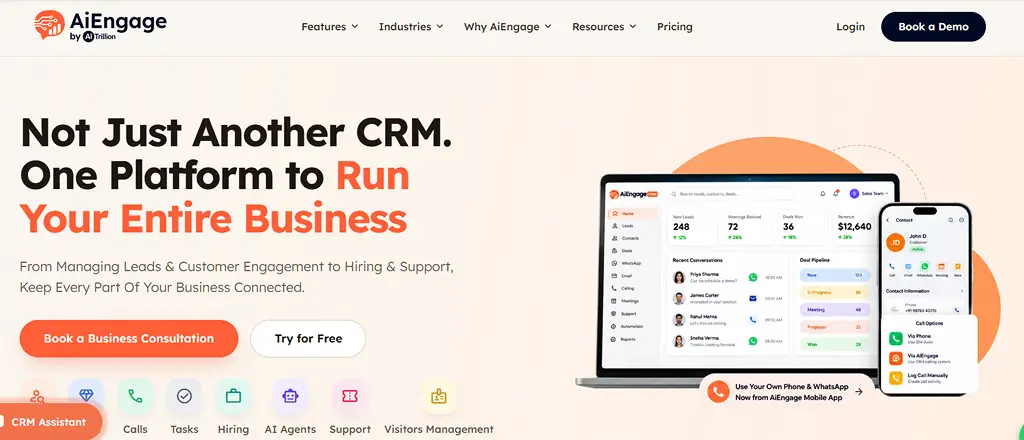
Built for teams that talk to clients mostly on WhatsApp, AiEngage handles the journey from first inquiry to onboarding. Its WhatsApp AI agent answers common questions, asks for basic documents, and books a meeting before passing the chat to an advisor, along with a short summary. It suits insurance agencies, loan companies, mutual fund distributors and wealth managers in India. It is not a portfolio management tool, and firms that need custodian data feeds should check integrations during the demo.
Key features
WhatsApp AI agent that qualifies inquiries and books consultations
Lead routing by product, language, branch or advisor availability
Document checklists that show received and pending items
Reminders for renewals, payments, maturity and follow-ups
Shared team inbox with multiple WhatsApp numbers and cloud calling
Pricing plans
Professional CRM: custom pricing
Business AI: custom pricing
Enterprise AI: custom pricing
Quotes include a setup fee, user licenses and usage charges.
2. Salesforce Financial Services Cloud
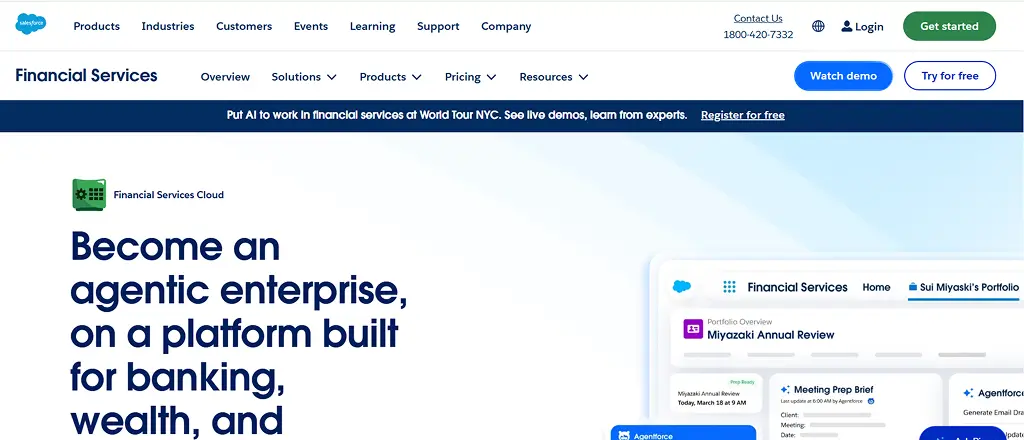
Banks and big wealth firms pick this platform because it can be shaped around almost any process. It comes with ready data models for households, accounts and financial goals. The catch is money and effort. Most firms need an implementation partner and an in-house admin team, and for a small practice it is usually more system than needed.
Key features
Finance-specific data models for households, accounts, and goals
Client segmentation and financial goal tracking
AI and Agentforce credits included in every plan
Backup, sandbox and security center in Advanced and Max plans
Pricing plans (per user per month, billed annually)
Core: $325
Advanced: $500
Max: $700
Sales and Service editions are priced separately at the same levels.
3. Wealthbox
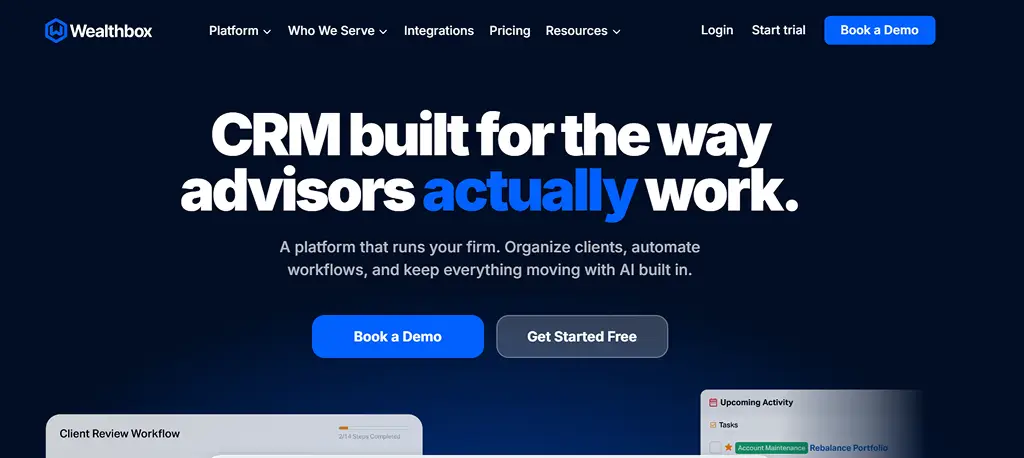
A favourite among independent US advisors, this CRM is known for an interface that new team members pick up quickly. It covers contacts, households, tasks and pipelines without much setup. The downside is per-user pricing that grows with every hire, and its AI notetaker is a paid add-on. It is built for the US market and has no WhatsApp focus.
Key features
Contact and household management
Task management, calendar and meetings
Workflows and automations (Pro plan and above)
Two-way email sync and broadcast email (Pro plan and above)
Pricing plans (per user per month)
Basic: $59
Pro: $75
Premier: $99
Enterprise: custom pricing
4. Redtail CRM
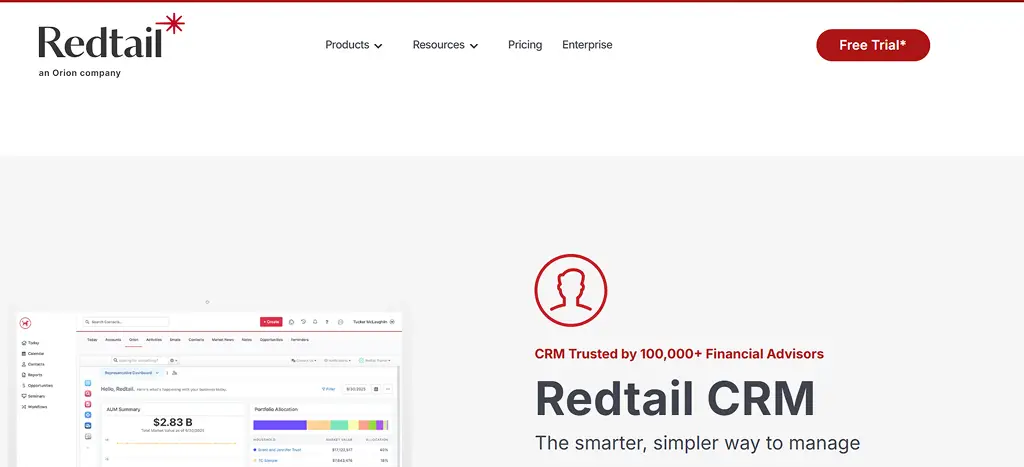
Designed only for financial advisors, Redtail has been part of US advisory firms for a long time. SmartAsset notes that it was used by around 43% of financial planning firms in the 2026 T3/Inside Information Software Survey. It costs less than most advisor CRMs and connects with hundreds of tools. On the flip side, some users find the screens dated, and the entry plan allows only five users.
Key features
Contact and account management with custom segmentation
Secure mobile app
Process workflows and automation triggers (Growth plan)
Document storage and compliant texting, subject to broker-dealer approval (Growth plan)
Pricing plans (per user per month)
Launch: $39 billed yearly or $45 monthly, up to five users
Growth: $59 billed yearly or $65 monthly
Enterprise: custom pricing
5. Zoho CRM
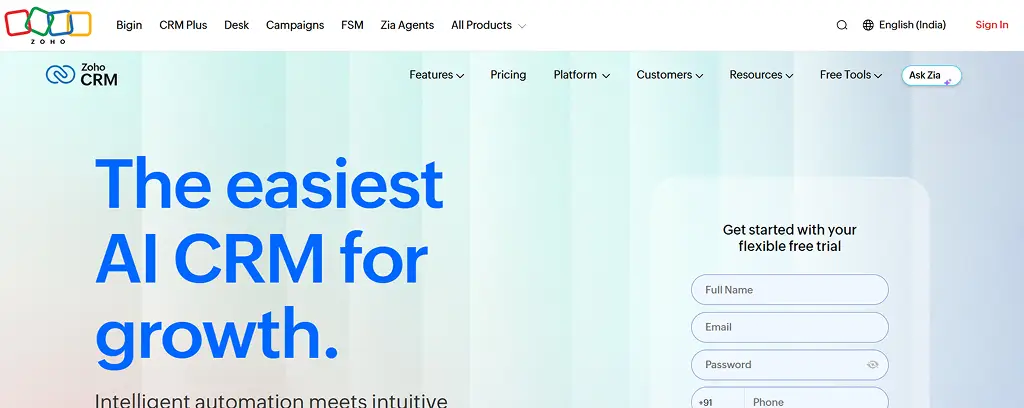
Firms watching their budget often start here because it is cheap and flexible. With custom modules and fields, you can shape it to track households, policies, or SIPs. That setup takes time, though, as there are no finance workflows ready to use. It works best when someone in your team enjoys setting up software.
Key features
Web forms for lead capture and multiple sales pipelines
Workflow automation and custom modules
Calling, email integration and mass emails
Field-level encryption and Zia AI on the Enterprise plan
Pricing plans (per user per month)
Free: up to 3 users
Standard: $14 billed yearly or $20 monthly
Professional: $23 billed yearly or $35 monthly
Enterprise: $40 billed yearly or $50 monthly
Ultimate: $52 billed yearly or $65 monthly
6. HubSpot CRM
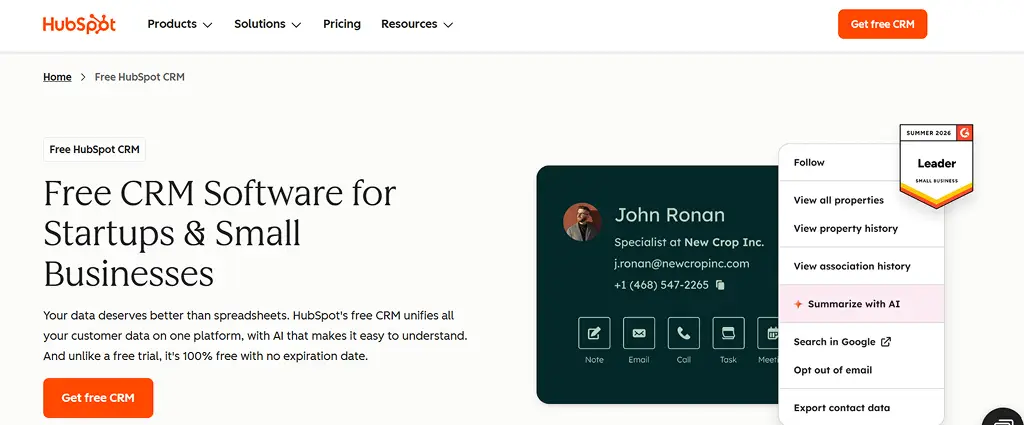
Firms that send newsletters, run webinars and post market updates get a lot out of HubSpot's marketing side. You can start free and add paid features as you grow, but advanced automation sits in tiers that get expensive. With no finance data model, household views and document tracking need workarounds.
Key features
Email templates, snippets and meeting booking links
Calling with 500 minutes on the Starter plan
Up to 50 workflows and 15 pipelines on Starter
Reporting dashboards on every plan
Pricing plans
Free: $0 for up to 2 users
Starter: from $20 per seat per month
Professional and Enterprise: higher, see HubSpot's pricing page
How WhatsApp and Automation Improve Client Engagement for Financial Planners
Most Indian advisors will tell you clients reply on WhatsApp within minutes, but leave emails unread for days. Those chats usually sit on the advisor's own phone, with no company record.
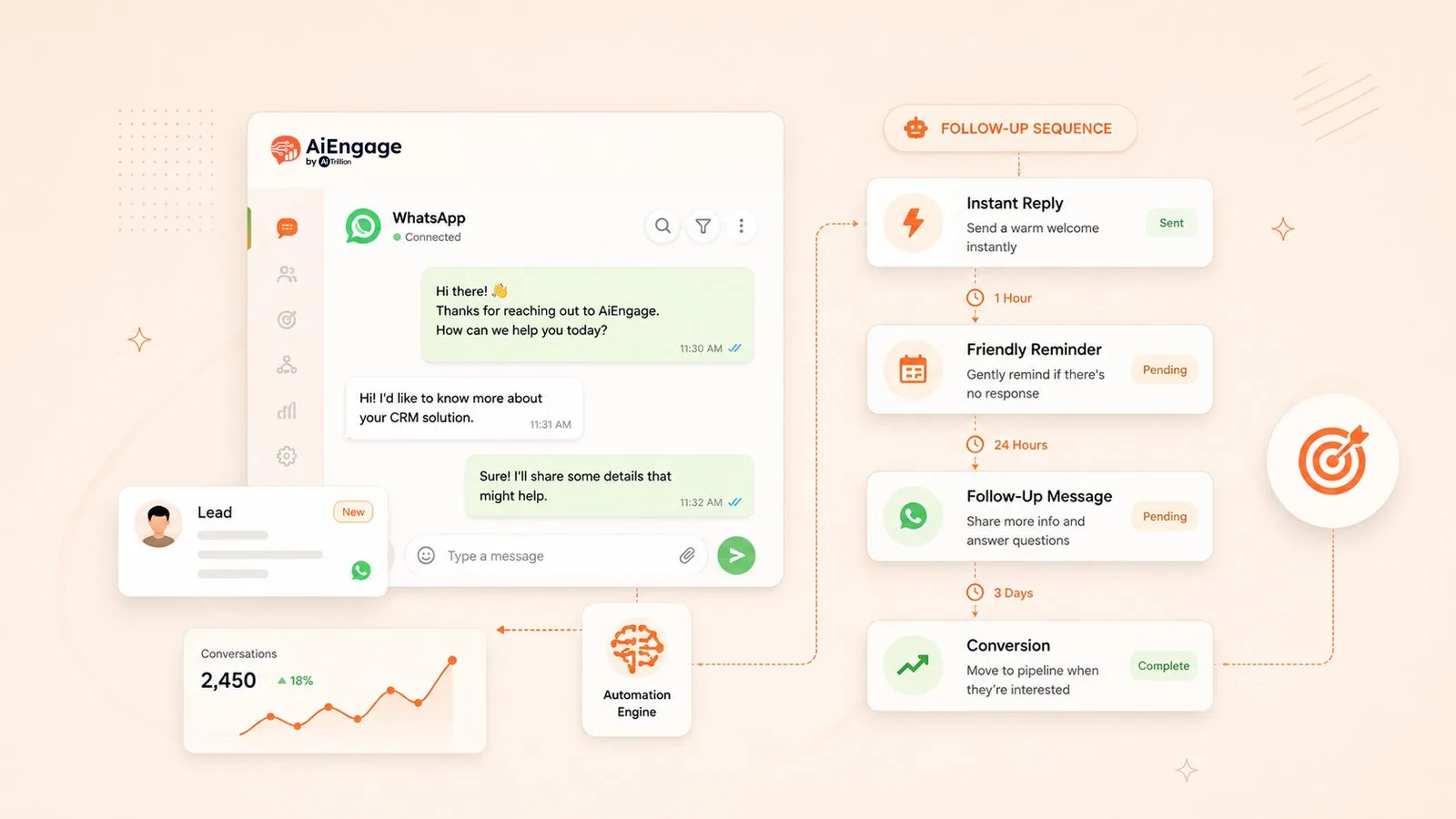
A crm for financial planners that connects to the WhatsApp Business API keeps every chat in a shared inbox, linked to the client's record. A few workflows that save real time:
Document reminders: A message lists pending KYC papers and follows up until they arrive.
Review meeting nudges: Clients get a booking link before their portfolio review.
Renewal and maturity alerts: Policy renewals, FD maturity dates, and EMI reminders go out on time.
Market updates: Approved updates reach clients who opted in, in one click.
Message only clients who opted in. When a crm for financial planners takes care of these routine jobs, advisors get more time for conversations that build trust.
How to Pick the Right CRM for Wealth Management Based on Firm Size
Here is how I guide firms of different sizes when they shortlist a CRM for wealth management.
Solo advisors and small teams (1 to 5 people): A crm for financial advisors at this stage needs quick setup, a mobile app, and WhatsApp in one place.
Mid-size firms, insurance agencies and distributors (5 to 50 people): Lead routing, role-based access and advisor reports start to matter. Our breakdown of HubSpot vs Zoho vs AiEngage shows how each one handles these needs.
Banks, NBFCs and large wealth firms: A crm for banks needs strict access controls, detailed audit trails, core banking integrations and room for hundreds of users. Plan for a longer rollout. Many lending teams also run a lighter crm for banks next to the main system for inquiries and WhatsApp follow-up.
Whatever your size, test the CRM with real client work for two weeks before you sign.
Conclusion
Trust in finance is built in small moments: the reminder that came on time, the advisor who remembered your last talk. The best crm for wealth management is the one that protects those moments even when your team is stretched.
If most of your client chats happen on WhatsApp, AiEngage CRM is worth a closer look. Bring your real workflow to the call, and we will show you how it runs inside the CRM.
Book a Walkthrough With Your Own Client Workflow
FAQs
Question: Is a general CRM safe for storing client financial data?
Answer: It can be, if the CRM offers role-based access, audit trails, two-factor login, and encrypted backups. Many general CRMs have these features, but they are often locked in higher plans. Before you move client files, confirm where the data is stored and who inside the vendor's team can access it.
Question: How much does a wealth management CRM cost?
Answer: Prices range from free plans on Zoho and HubSpot to $325 per user per month on Salesforce Financial Services Cloud. Advisor-focused tools like Wealthbox and Redtail sit in the middle, between $39 and $99 per user per month. AiEngage CRM gives custom pricing based on your team size, setup needs, and WhatsApp usage.
Question: Can a CRM help with compliance for financial firms?
Answer: A CRM supports compliance, but it does not guarantee it. Audit logs show who changed what, consent records prove that clients agreed to receive messages, and document history shows what was shared and when.
Question: Do financial firms need WhatsApp integration in their CRM?
Answer: For firms in India, it is close to a must, because that is where most clients reply fastest. With WhatsApp inside the CRM, every chat stays linked to the client record instead of an advisor's personal phone. An AI chatbot for WhatsApp can also qualify new inquiries before they reach an advisor.


I help businesses simplify marketing, sales, and customer support through AI and automation. At AiEngage CRM, we bring lead management, WhatsApp, calling, email campaigns, meetings, and support into one connected platform. Our vision is to help businesses run smarter with AI, empowering teams to streamline everyday work, strengthen customer relationships, and drive sustainable growth.